
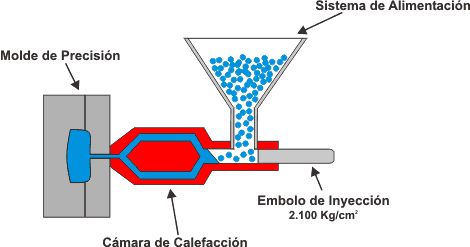
Injection molding is a process that involves injecting semi polymer or ceramic in the molten state (or rubberized) in a closed mold under pressure and cold, through a small hole called a gate. In that mold material solidifies, beginning to crystallize in semicrystalline polymers.
The final piece or part is obtained by opening the mold and remove from the casting cavity.
Polymers have succeeded in substituting other materials such as wood, metals, natural fibers, ceramics and even precious stones injection molding is a more environmentally friendly process compared to paper manufacturing, logging or chrome. It does not pollute the environment directly, does not emit gases or aqueous wastes with low levels of noise. However, not all plastics can be recycled and some that can be recycled are deposited in the environment, causing environmental damage.
The popularity of this method is explained with the versatility of parts that can be made, speed of manufacture, design scalable from rapid prototyping processes, high levels of production and low costs, high or low based on cost automation of the part geometries very difficult that would be impossible by other techniques, castings require little or no finish as they are finished with the desired surface roughness, color and transparency or opacity, good dimensional tolerances of castings with or without inserts and with different colors.


No hay comentarios:
Publicar un comentario